
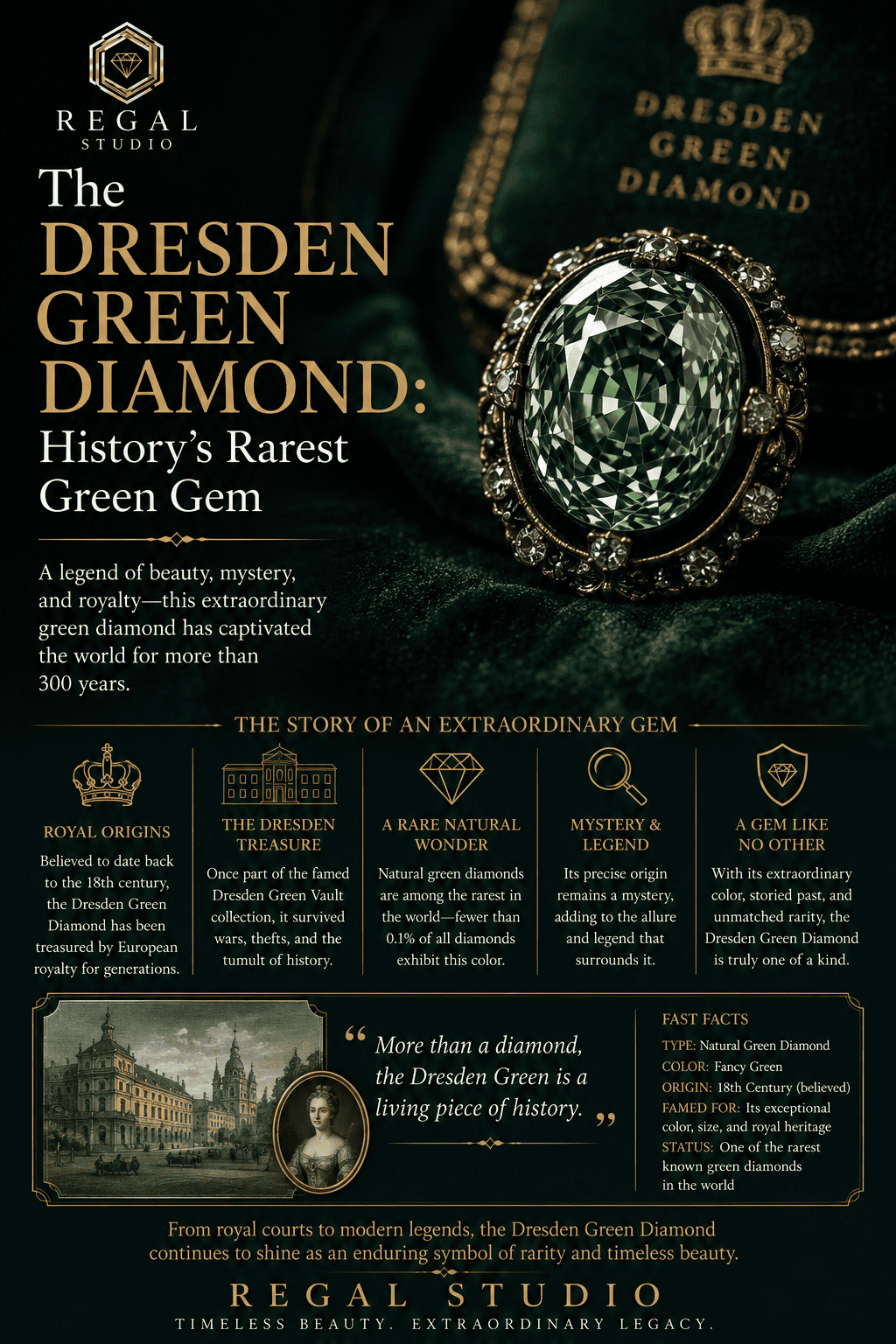


The Dresden Green Diamond: History’s Rarest Green Gem
Quick answer: The Dresden Green Diamond is a roughly 41-carat natural green diamond, the largest and finest ever found. Mined in India’s Golconda region before 1722, it owes its rare apple-green color to millions of years of natural radiation. Graded a rare Type IIa with VS1 clarity, it has been a Saxon crown treasure for nearly 300 years and remains on display in Dresden’s Green Vault today. No other green diamond in history compares to it.
So here is the full story of the world’s most remarkable green diamond, from its Indian origins to its brush with a modern heist.
A Note on Where This Analysis Comes From
This guide comes from Regal Studio in Buckhead, Atlanta. Our founder, Mack, began at the jeweler’s bench at just fourteen, trained across Europe, and is today a GIA Certified Diamond Grader with over 45 years of experience.
We have spent a career studying what makes a diamond truly exceptional. Few stones on Earth qualify like the Dresden Green.
So this is not a recycled encyclopedia entry. It is an expert’s look at why this gem stands alone.
What Is the Dresden Green Diamond?
Let us start with the essentials, since the numbers alone are extraordinary.
The Dresden Green is a natural green diamond weighing approximately 41 carats. It is the largest natural green diamond ever discovered, and by wide agreement the finest.
Its color is what stuns experts. A soft, even apple-green hue runs uniformly throughout the entire stone. That is almost unheard of in green diamonds.
A key insight often overlooked: in most green diamonds, the color sits only on the surface as a thin skin. In the Dresden Green, the green penetrates the whole crystal. That single trait sets it apart from every other green diamond on record.
The Dresden Green at a Glance
Feature | Detail |
Weight | ~41 carats (pear/almond brilliant cut) |
Color | Natural Fancy Green, evenly distributed |
Clarity | VS1 (potentially internally flawless if recut) |
Type | Type IIa (only ~2% of diamonds) |
Origin | Golconda region, India (likely Kollur Mine) |
Current home | Green Vault, Dresden, Germany |
Why Its Color Is So Extraordinarily Rare
To understand the Dresden Green, you have to understand how green diamonds form. It is unlike any other color.
Most diamond colors come from a chemical element. Blue comes from boron. Yellow comes from nitrogen.
Green is different. It comes from natural radiation. Over millions of years, radioactive minerals near the diamond bombard it, subtly altering its atomic structure and tinting it green.
A key insight often overlooked: this radiation usually affects only the outer layer. That is why cutting a green diamond is so risky, the green can literally disappear under the cutter’s wheel. The Dresden Green’s whole-stone color makes it a miracle of nature.
Experience has shown that this is exactly why natural green diamonds are among the rarest colors on Earth, and why the Dresden Green is the crown of them all.
The Type IIa Distinction: Chemical Purity
There is another layer to the Dresden Green’s rarity that most people never hear about.
It is a Type IIa diamond. This means it is nearly free of nitrogen, boron, and other impurities.
Only about 2% of all natural diamonds qualify as Type IIa. These stones are prized for exceptional transparency and purity. The famous Koh-i-Noor and Cullinan diamonds share this classification.
When the GIA examined the stone in 1988, they confirmed its Type IIa status, its remarkable transparency, and its VS1 clarity, praising it as one of the greatest diamonds in the world.

A History Spanning Three Centuries
The Dresden Green’s story is as rich as the stone itself.
Indian Origins
The diamond was mined in India’s legendary Golconda region, most likely the Kollur Mine. This is the same fabled source that produced many of history’s greatest diamonds.
Its documented history dates to 1722, when a London news-sheet reported on it. In rough form, the crystal likely weighed over 100 carats.
Royal Acquisition
In 1741, a Dutch merchant offered the stone at the Leipzig Fair. It was acquired for the House of Saxony, with the price rumored at 400,000 thaler, an immense fortune.
The Golden Fleece and the Hat Ornament
Frederick Augustus II first set the diamond in a Decoration of the Golden Fleece. That design was later dismantled.
In 1768, the jeweler created a magnificent hat ornament, surrounding the Dresden Green with two large and 411 smaller diamonds. Remarkably, that is still the setting the stone appears in today.
The Green Vault and the 2019 Heist
Here is the part of the story most evergreen articles miss, and it makes the Dresden Green’s survival feel almost miraculous.
For centuries, the diamond has been housed in Dresden’s Green Vault (Grünes Gewölbe), one of Europe’s oldest treasure collections.
In November 2019, thieves broke into the Green Vault in one of the most audacious jewel heists of modern times. They stole priceless Saxon treasures, with total losses estimated in the hundreds of millions.
A key insight often overlooked: the Dresden Green Diamond was not in the vault at the time. It was on loan, on display at New York’s Metropolitan Museum of Art. That fortunate timing likely saved it from the thieves.
The stolen pieces included the Dresden White Diamond and other crown treasures. Some were later recovered; the collection has reopened to the public.
Where the Dresden Green Is Today
The diamond has since returned home. It remains on display in Dresden’s New Green Vault, now under heightened security.
Experience has shown that few gemstones combine such rarity, beauty, and dramatic history. The Dresden Green is priceless in the truest sense. It has never been sold at auction, and almost certainly never will be.
What Makes the Dresden Green Priceless
Put the elements together and you understand why no price tag applies.
- Rarest color, formed by radiation, not chemistry.
- Color throughout the stone, not just the surface.
- Type IIa purity, shared by only 2% of diamonds.
- The largest natural green diamond ever found.
- Nearly 300 years of documented royal history.
- A survivor of war and a modern heist.
In our market observations, collectors chase individual traits like these. The Dresden Green possesses all of them at once. That combination is why it stands alone in the history of gems.

How It Compares to Other Famous Green Diamonds
The Dresden Green is not the only notable green diamond, but it towers over the rest.
The Aurora Green, a 5.03-carat Fancy Vivid Green, sold for around $16.8 million in 2016, about $3.3 million per carat, a record for a green diamond at auction. Yet it is a fraction of the Dresden Green’s size.
A key insight often overlooked: natural green diamonds routinely command far more than treated ones. Treated green diamonds may sell for $3,000 to $10,000 per carat, while natural stones of quality reach into the millions. The Dresden Green is beyond even that scale.
Frequently Asked Questions
How big is the Dresden Green Diamond?
It weighs approximately 41 carats and is the largest natural green diamond ever discovered. Its dimensions are about 29.75 x 19.88 x 10.29 mm, cut in a pear or almond brilliant shape.What gives the Dresden Green its color?
Natural radiation over millions of years. Unlike blue (boron) or yellow (nitrogen), green diamonds get their color from radioactive exposure that alters the crystal’s structure. Uniquely, the Dresden Green’s color runs through the entire stone.How much is the Dresden Green Diamond worth?
It is considered priceless and has never been sold at auction. As the largest, finest natural green diamond in existence and a centuries-old crown treasure, its cultural and historical value is beyond any market price.Where is the Dresden Green Diamond now?
It is on display in the New Green Vault at the Dresden State Art Collections in Dresden, Germany, housed in the same 1768 hat ornament and kept under heightened security.Was the Dresden Green stolen in the 2019 heist?
No. During the November 2019 Green Vault burglary, the Dresden Green was on loan to New York’s Metropolitan Museum of Art, which spared it from the theft. Other Saxon treasures were stolen.
Discover Rare and Exceptional Diamonds in Atlanta
Legendary stones like the Dresden Green remind us what makes a diamond truly extraordinary: rarity, natural color, and impeccable quality. Understanding those qualities is the difference between a good diamond and a great one.
At Regal Studio in Buckhead, every piece is designed and handcrafted by Mack, a GIA Certified Diamond Grader with over 45 years of experience and the trust of more than 278 five-star clients. Whether you are drawn to fancy color diamonds or a flawless classic, we help you understand and source the finest stones with complete transparency.
Our motto says it all: “You Dream It, We Make It.”
Visit Regal Studio on Peachtree Road in Buckhead, or get in touch to book a consultation. Let a seasoned master jeweler help you find a diamond worthy of its own story.
Read More:
How Many Red Diamonds Are Left in the World? The Complete 2026 Count
Ring Resizing Near Me: Atlanta’s Trusted Sizing Experts Explain the Process